
Riverhead City Directory Holdings
Riverhead has one directly inspected historical city directory and several important catalog leads. Curtin’s 1868/69 volume is available online and is the clearest starting point for a person, trade, or intersection from that period. The Suffolk County Historical Society holdings list adds earlier, later, and business-focused books. Those titles can help place a Riverhead name in a particular period, but they are not a continuous household roll. Confirm the physical volume, its Riverhead pages, and any access restriction before relying on a finding-aid entry.
| Collection | Years | Where held | Access |
|---|---|---|---|
| Curtin’s Riverhead Directory | 1868/69 | Digitized directory page; local-history institutions for physical confirmation | Online name, role, and intersection search |
| Boyd’s Long Island Directory | 1864/65 | Suffolk County Historical Society holdings list | Confirm the volume and Riverhead coverage in person |
| Brooklyn & Long Island and Lain’s business directories | 1889; 1889–1897 | Suffolk County Historical Society holdings list | Riverhead business and professional context, not a full resident roll |
| Business Directory Long Island and Olek’s Nassau/Suffolk directory | 1895; 1924/25 | Suffolk County Historical Society holdings list | Confirm edition completeness and Riverhead indexing |
Riverhead city directories have uneven survival. The holdings page is a useful lead, not proof that every listed edition is on the shelf or contains a complete Riverhead section. A missing name can reflect the book’s scope, a spelling variant, or an unlisted household. It does not settle where someone lived.
See the Suffolk and Riverhead directory holdings list before arranging a visit. It identifies the titles, while staff can confirm access and the most useful pages.
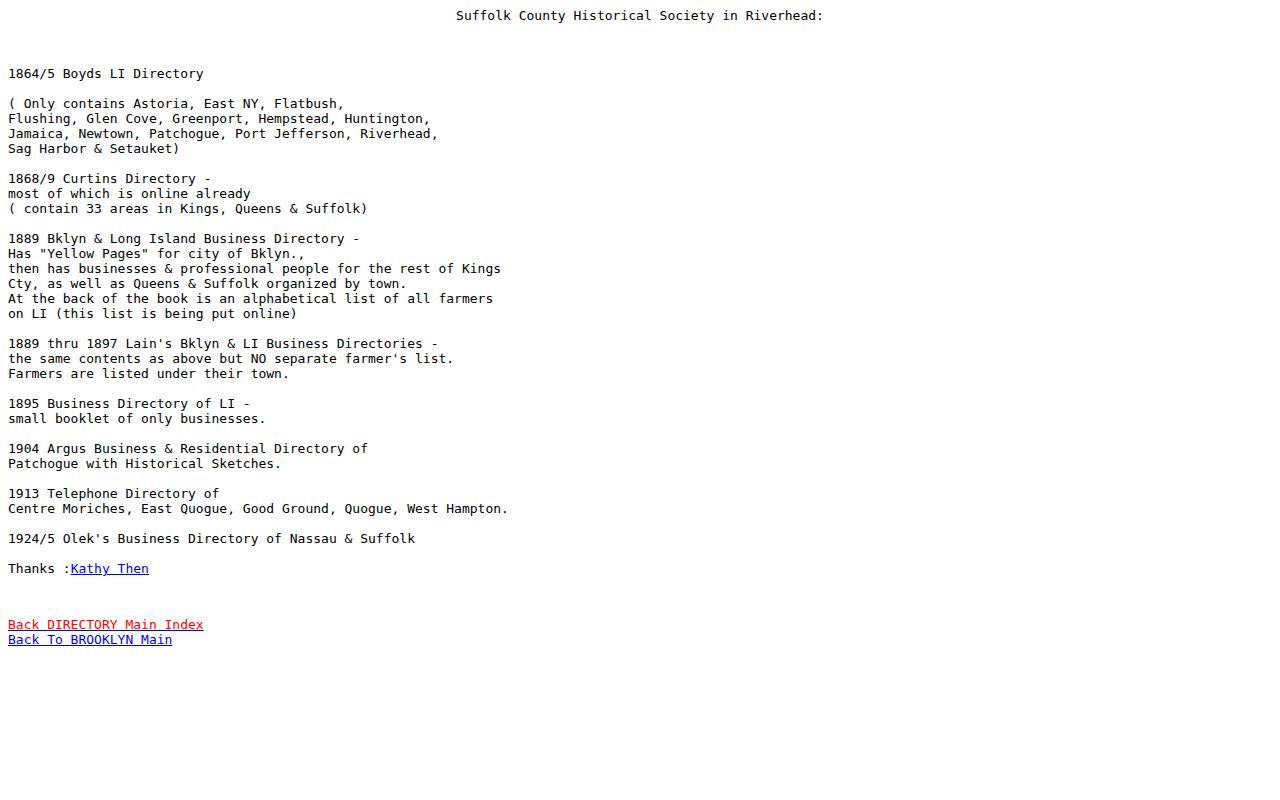
The holdings view is a practical reminder to record the publisher and edition before copying a Riverhead entry. That Riverhead information makes the lead reproducible later.
Curtin’s Riverhead Directory, 1868/69
Curtin’s digitized Riverhead directory is arranged around surname, given name, recorded trade or civic role, and address or intersection. It preserves the town’s commercial geography in compact lines. Orville B. Akerly appears with a country store on Main near Griffing Avenue. Thaddeus H. Corwin is identified as postmaster on Main, with a home on Abner. Charles Hallett’s mill and home location connect Bridge near Main with Griffing Avenue and North Second. These are historical descriptions, not modern map coordinates.
The volume also shows why a city directory should be read as a period source. Olindia Annie Adams is described as a widow of John, while Nathaniel Downs is listed at Court House. The wording, spelling, and landmarks should be transcribed as printed. Do not modernize a relationship or turn an intersection into a numbered address without separate evidence.
The Curtin directory interface preserves the 1868/69 Riverhead entry layout.
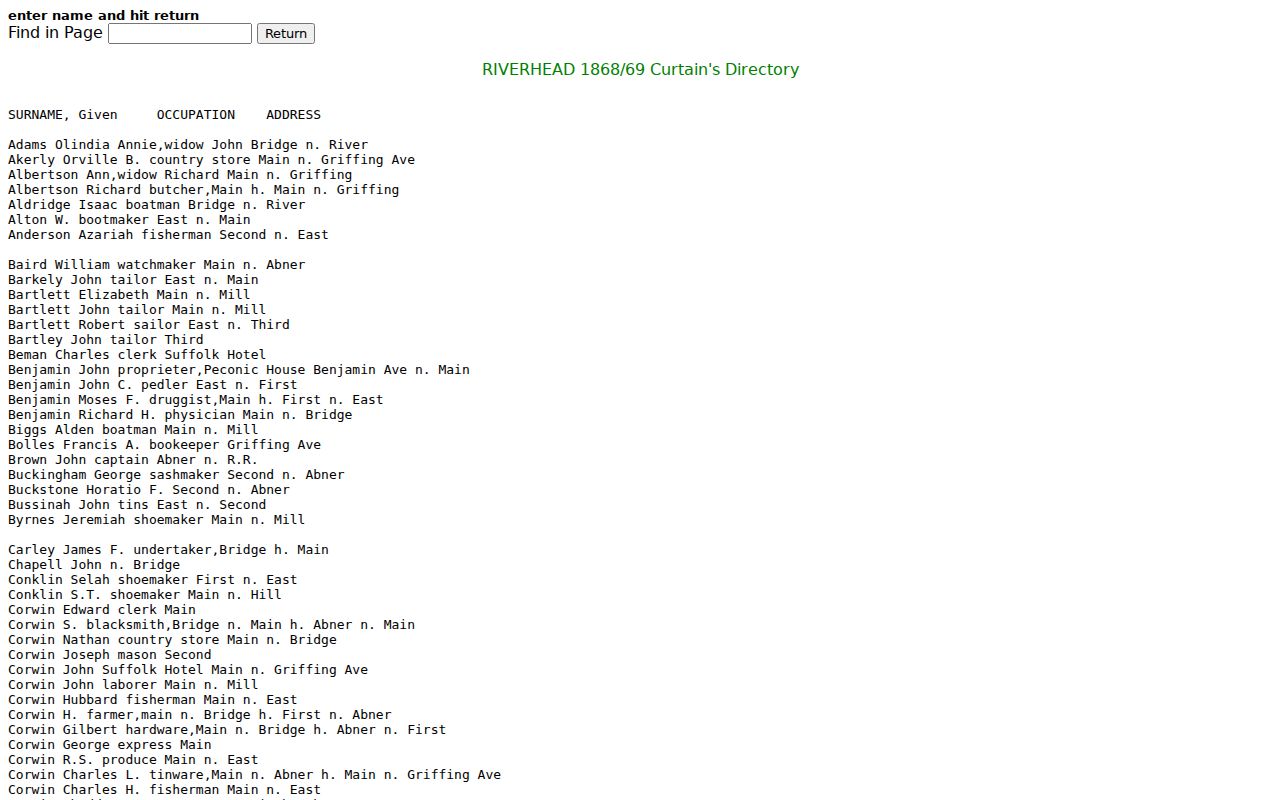
Use its exact spelling as the starting point for a Riverhead search, then test initials, reversed name order, and the same intersection in other records.
Riverhead directory sequence. 1864/65 Boyd’s volume is an identified holdings lead; Curtin’s 1868/69 title is directly searchable; business titles appear for 1889, 1889 through 1897, and 1895; Olek’s later Nassau/Suffolk book reaches 1924/25. Telephone catalogs add possible 1910, 1912, 1936–37, and 1938–39 layers, subject to service-area checks.
Note: A publisher year identifies a possible research layer, while the title page and Riverhead pages determine whether the volume fits a particular search.
How Riverhead City Directory Entries Read
Each Riverhead Curtin line is a small inventory rather than a modern profile. The most useful details are the source spelling, the printed role, the business or home place, any household-status wording, and the landmark used to locate the entry. A store on Main and a home near another intersection can describe two different places for the same person. Keep both. Riverhead’s old city directory entries commonly use intersections, so an apparent match needs a second attribute before it can support an identity conclusion.
| Name | Copy the surname, given name, initials, and punctuation as printed; later searches may use a different order. |
|---|---|
| Recorded role | A trade, office, or civic description that supplies historical context, not a current status. |
| Place | A business location, home location, landmark, or intersection, often without a modern street number. |
| Household wording | A widow or other period description that is a lead for marriage, probate, or newspaper research. |
| Abbreviation | Read the volume’s key first. In context, n. can mean near or north, c. corner, and h. home; r. can mean residence or rear. |
- City directory
- A dated directory of names and places. Its scope may be household, commercial, or both, depending on the volume.
- Criss-cross directory
- A reverse, street-order listing that can connect an address to printed names. No confirmed Riverhead reverse title or year was located, so ask the library or Historical Society rather than assuming one exists.
- Householder index
- A name-oriented list of households. A business directory may not provide one, and a name’s absence is not proof of absence from Riverhead.
- Abbreviation key
- The publisher’s explanation of shortened terms. Photograph or transcribe it with the entry before expanding an uncertain mark.
Riverhead Directory Research Desks
The Perkins Local History Collection at Riverhead Free Library is a strong place to resolve a directory entry with newspapers, local history, and genealogy help. The library is at 330 Court Street and offers no-charge, one-hour genealogy appointments on Tuesdays and Wednesdays. Listed hours are Sunday noon to 4, Monday through Thursday 9 to 8, and Friday through Saturday 9 to 5. An appointment is help with a collection, not a searchable resident database.
The New York Heritage profile for Riverhead Free Library describes the Perkins collection as a Riverhead Town collection and gives useful institutional context.
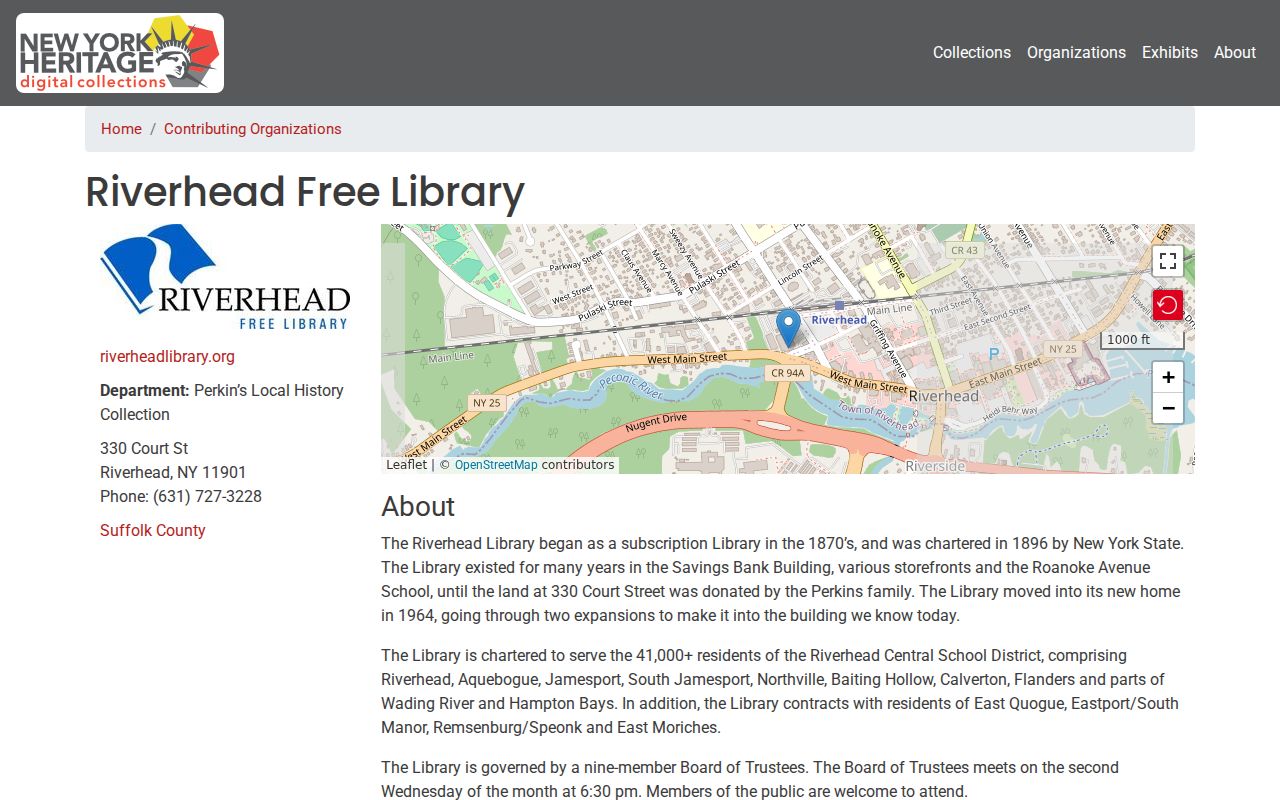
Bring the entry transcription, the edition year, and any known street or relative name to a Riverhead appointment. Those details let staff point to the most relevant newspaper or map source.
The Suffolk County Historical Society research library at 300 West Main Street is the other key in-person route. It lists Wednesday through Friday research hours of 12:30 to 4:30, with Saturday by appointment. The research-library daily fee is listed as $5 for nonmembers, while members and students under 14 are free. Contact ahead to confirm the directory title, its condition, and access rules.
The Historical Society visit information identifies the Riverhead research-library route and its appointment guidance.
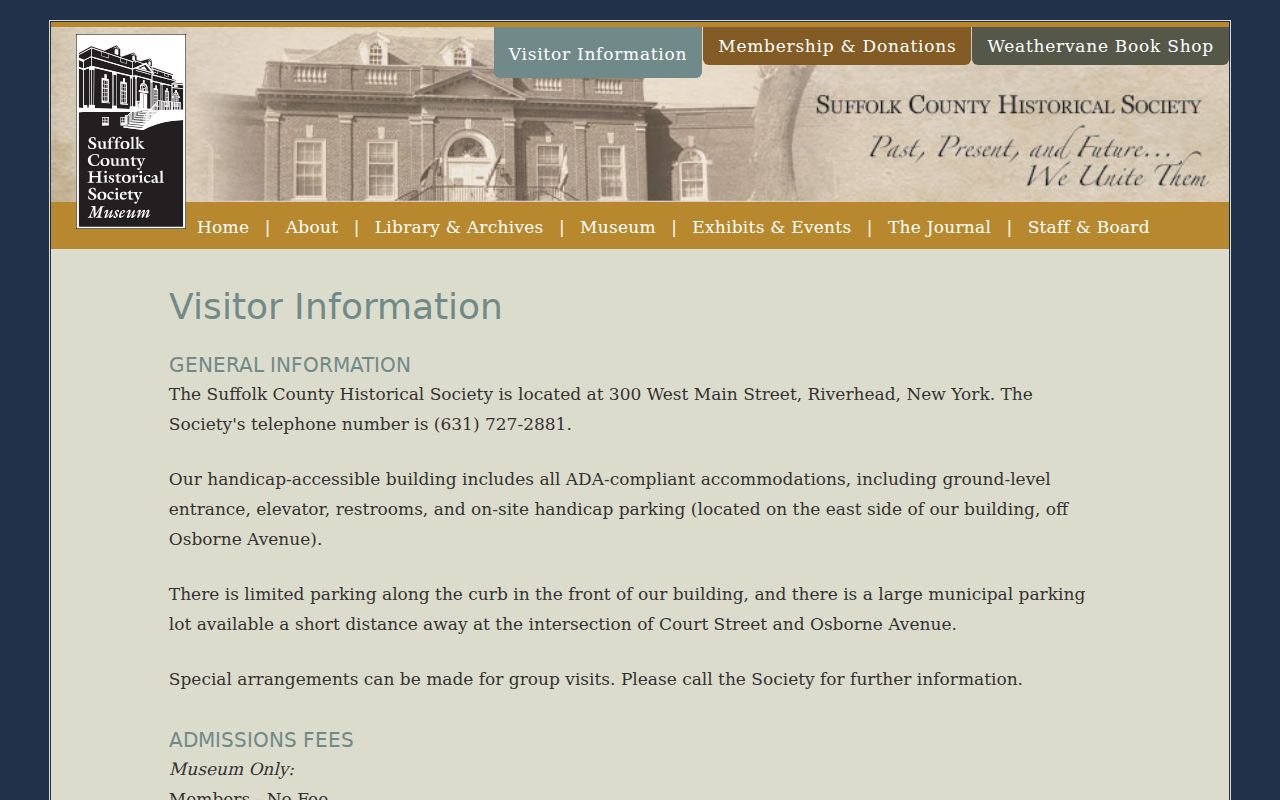
A staff-confirmed volume is stronger than an unverified catalog lead, especially when a Riverhead page may be missing or outside the book’s service area.
Note: Library and Historical Society schedules, appointments, fees, and collection access can change, so confirm them before a Riverhead research visit.
Riverhead Telephone Directory Leads
Riverhead telephone books can add a later layer to a Riverhead city directory search. The Patchogue-Medford Library genealogy catalog identifies Independent Telephone titles for Baiting Hollow and Roanoke connections in 1910 and 1912, plus Eastern Suffolk County telephone directories for 1936–37 and 1938–39. Those catalogs can reveal subscriber and service-area clues. They do not establish that every Riverhead household appears or that a named subscriber lived at a particular place.
Check the title page and coverage statement before using a telephone volume. The 1910 and 1912 entries specifically mention connecting lines, and the eastern or western Suffolk labels may not map neatly onto the Town. A listed number or location should be paired with a newspaper, directory, deed, or other date-specific source.
Note: The public research did not locate a confirmed Riverhead reverse-directory title or a separate public obituary-index page, so library staff remain the proper holdings check.
Riverhead Directory Names in Context
Names move between Riverhead sources. A Riverhead city directory may use initials, an abbreviated given name, a married surname, a widow descriptor, or a role connected to a store or civic office. Search both a full form and a compact form when an index allows it, such as Thaddeus H. Corwin and Corwin T. Compare the printed intersection and role before joining two records. Similar Riverhead names in the same town are not automatically the same person.
Preserve dates as carefully as names. A directory edition date, deed recording date, assessment year, newspaper publication date, and certificate issue date are different facts. If a recorded transfer and a Riverhead listing seem out of sequence, report both dates rather than forcing them into one story. A historical listing can lead to a County Clerk document or a probate search, but it is not a substitute for either.
Trace Families in Riverhead Directories
A careful Riverhead directory trail builds outward from one dated entry. Start with the oldest volume that contains the exact printed name, then follow changes in spelling, intersection, and role. Pair a directory line with the evidence that answers a different question: a map for place, a deed for recorded transfer, a newspaper for a published notice, or a vital record through its lawful request path. The County Clerk Historic Documents Library also holds maps and land materials that can help interpret an old Riverhead intersection.
- Record the full citation, edition year, printed name, role, and every place reference from the first Riverhead entry.
- Search a second directory year or telephone lead with exact and starts-with name forms, noting each change rather than silently normalizing it.
- Compare the intersection with a bound atlas, the 1897 Riverhead Sanborn target, or a County Clerk map. Do not back-project a current number into the old source.
- Use library newspaper resources for a dated notice, and use probate only when the record trail identifies an heir or estate question.
- Label the result confirmed by two sources, a plausible lead, an unresolved same-name match, or a gap that needs a custodian visit.
A disappearance from a city directory can mean a move, a change in the book’s scope, a different spelling, or no entry for that person. It does not by itself establish death or departure. The historical record is strongest when its limits are kept beside its clues.
Note: A census result should retain its exact enumeration geography and year, because a later ZIP or Town boundary is not historical proof.
Limits of Riverhead City Directories
Riverhead city directories are useful because they capture place names that later systems may not retain. They cannot prove a modern address, current residence, legal title, or present commercial status. A directory role is a historical observation. A business place is not necessarily a home place. A single surname hit may belong to another person. These limits matter most when a record is copied from one era into another.
Riverhead’s older record trail also has an archival boundary. The Riverhead County Clerk historic workflow uses grantor and grantee books for pre-1969 land research, while later terminals and online sources have different coverage. Bound atlases begin around 1873, and the identified 1897 Riverhead Sanborn item has six sheets, but exact sheet labels still need inspection. Treat an incomplete online image as a Riverhead research gap, then ask the holding institution for the next source.
Best next check. Keep the original Riverhead spelling and intersection beside every search result. A map, newspaper, or county record should confirm the connection before a family conclusion is made.